Can't see the trees for the wood
I recently rescued my 25 year old Marin MTB from a garden shed and with help from a Spanish mechanic, lots of pointing and a bunch of parts from Halfords managed to get it functional again. I very quickly found that I have absolutely no interest in cycling on the road, especially in the UK. It's immensely dull, grindingly repetitive and it feels like any fitness gains are largely outweighed by spending several hours breathing in petrol and diesel fumes. Not to mention the constant risk of death by mindless drivers.
Casting about for inspiration I discovered that Forestry England have created single-track cycle routes in many of their forests. Well signposted, dedicated cycle paths with all the fun stuff - berms, dropoffs, rollovers, twisty technical single-track. The sort of cycling I haven't done since probably my uni days. Figuring a wet, muddy march day is as good a time as any to try out risky mountain biking for the first time in 20 years I headed off to Bedgebury forest.
It was a bit of a revelation if I'm honest. I hadn't had that much fun cycling in a long long time. Granted I had to stop every 10 minutes to recover, a relatively fit person could probably have jogged the 8 mile total distance in less time than I took to ride it! But it was genuinely fun enough to just enjoy it for what it is. Remembering what it's like to cycle with a smile on your face, getting that rush of adrenaline as you realise you're flying headlong into a tricky section, negotiating it and pumping through the next berm. It's why I spent a grand on a bike 25 years ago in the first place! I must have somehow forgotten the fun of it when I became a cycling commuter, riding my road bike to work and back, thinking this is what cycling is now. Something that gets you to work and back while keeping you fit and saving money. A productivity machine, part of the daily grind to be better, healthier, more productive.
Anyway enough of that, save the neoliberal navel gazing for another post. What interests me today is forests. Specifically the ones run by Forestry England. Because I have a problem. On the one hand I love these cycle routes, they clearly take a bit of work to set up and maintain and I'm very happy that there is an organisation doing that. On the other hand in some ways Forestry England is to woodland what the shooting association is to moorland. They make an awful lot of claims about natural spaces, preserving nature and so forth, and to be fair they have done some good work in this area with a biodiversity action plan in place they have restored some important habitats and worked with other organisations to reintroduce species including white tailed eagles. However this is arguably in spite of, rather than because of their legal duties.
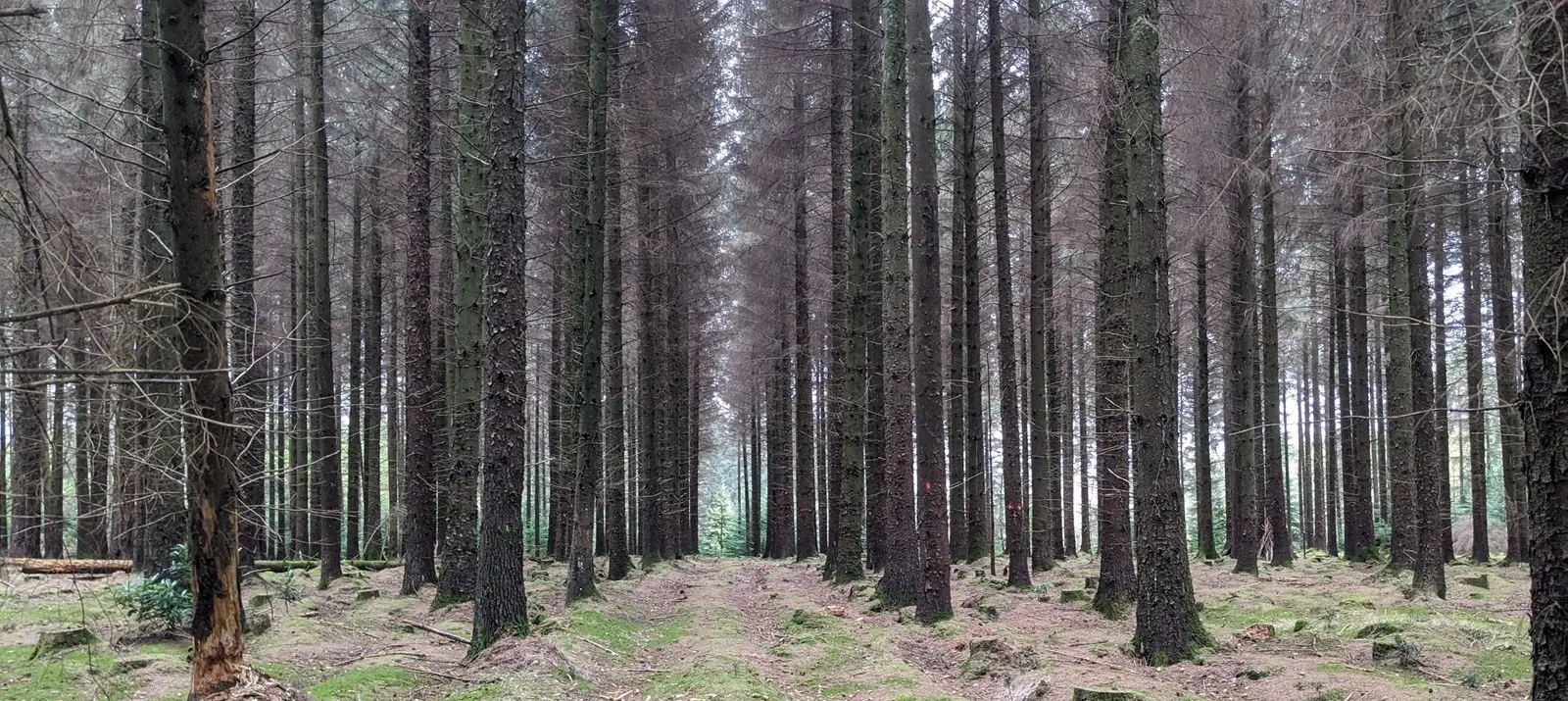
Their primary legal mandate is timber production - the planting and felling of primarily pine plantations in a completely artificial, unnatural manner. Let's be clear, these plantations are not woodlands in the same way that a farm is not a wildflower meadow. There may be some superficial similarities (IE trees!) but there is absolutely none of the rich complexity of a natural ecosystem in a pine plantation. Rows and rows of identical pine trees are no more than a tree farm. There is no undergrowth, no diversity of tree types, sizes or ages, even the soil itself is heavily degraded with the mycorrhizal networks destroyed by planting and logging machines. You can often see furrows along the lines of trees looking exactly like a ploughed field. Even the needles from the pine trees don't compost down in the same way as deciduous leaves, instead they acidify the soil, another barrier to anything else attempting to grow there. Sunlight rarely makes it to the ground in any case, blocked out by the optimally spaced identical rows of Norwegian spruce. With no undergrowth and no food source there is nothing for birds or animals here. Inside these forests it is dark, silent and still.
What's more, while many plantations are on old, unproductive farmland, around 223,000 hectares are designated as PAWS (plantations on ancient woodland) which means they have directly ripped apart our ancient woodlands - the most biodiverse, natural places we have, and replaced them with monoculture timber plantations. While this practice was stopped in the 80s, restoration has been slow. To quote Wildlife and Countryside Link:
There is a target for Defra within the Keepers of time policy to bring the majority of ancient woodland damaged by plantation forestry (PAWS) into restoration by 2030. This is fundamental to wider Defra legal targets on nature recovery and habitat restoration. Most of the damaged ancient woodland is privately owned. Forest Services are the primary delivery body and need to support approximately 5,000ha into restoration each year to meet Defra’s target. However, progress has been exceptionally slow. In 2022/23, Forestry Commission England supported only 1ha of privately owned PAWS restoration across England, rising only to 6ha in 2023/24. This is arguably one of the worst performing environmental targets under DEFRA’s responsibility.
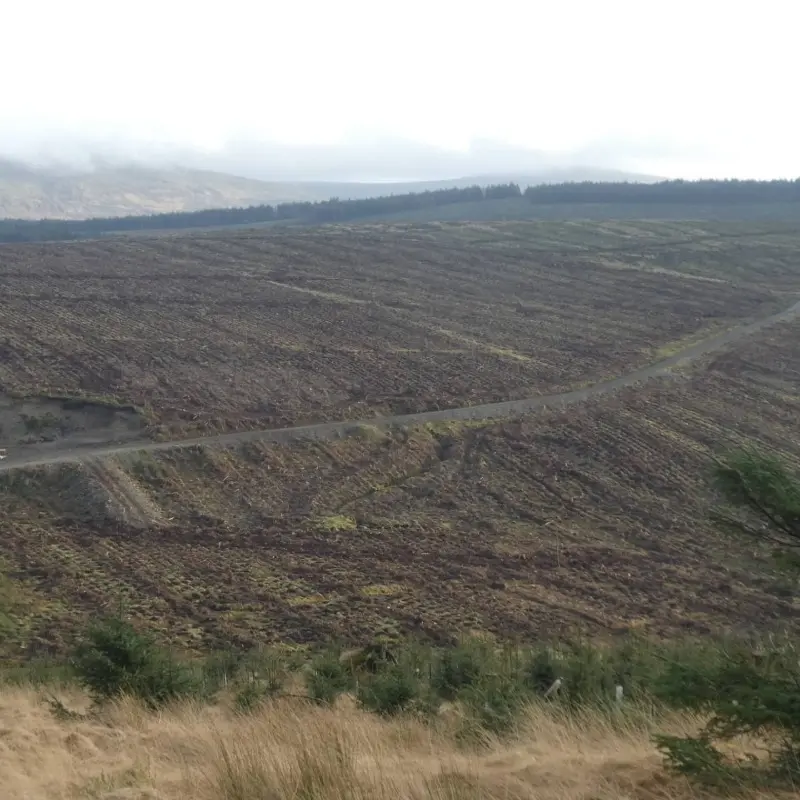
That being said, unlike shooting estates which provide nothing for nature and nothing for the majority of the population except a fake idea of “wilderness”, these “tree farms” do produce useful resources which we currently need (although whether we actually need as many as we consume is another matter). So it should be a question of balance, they have a legal mandate to provide this timber but there should also be a legal requirement to balance what we are taking from nature by restoring and rewilding as much as possible. Indeed back in 1985 a clause was added to require "a reasonable balance" between timber production and the conservation of natural beauty, flora and fauna. However since this balance is undefined it is essentially meaningless
The Wcl are campaigning to have legally binding nature targets added to the forestry commissions legal mandate (link) which I think would be an excellent idea. Although as always with these sorts of top down targets we should be careful to avoid making simplified metrics the sole definer of success. In a sense that's how we got into this position in the first place, remember Goodharts law.
There's a book by the political scientist James Scott called Seeing Like a State which opens with almost exactly this situation. He describes how 18th century German foresters, tasked with maximising timber yield, reduced the complexity of natural woodland down to a single measurable output: wood. Everything that couldn't be counted as timber — the understorey plants, the insects, the fungal networks, the soil ecology — was irrelevant noise. They replanted their forests in perfect uniform rows of a single species, optimised for harvest. It worked brilliantly, for one generation. Then the forests started dying, because it turns out all that irrelevant noise was actually the thing keeping the ecosystem alive. Scott uses this as a metaphor for how institutions simplify messy, complex reality into something legible and manageable — and in doing so, destroy the very thing they were meant to steward.
The Forestry Commission was founded on almost identical logic. Its legal mandate is timber. Everything else — the ancient woodland remnants, the red squirrels, the veteran trees, the mycorrhizal networks threading through the soil — exists outside the metric that matters. And when you only count the wood, you stop seeing the trees.
When you're immersed in it however, flying along a root riddled trail on a 25 year old bike, not seeing the trees is not an option!